
Social Determinants of Health and HIV Outcomes Data Update
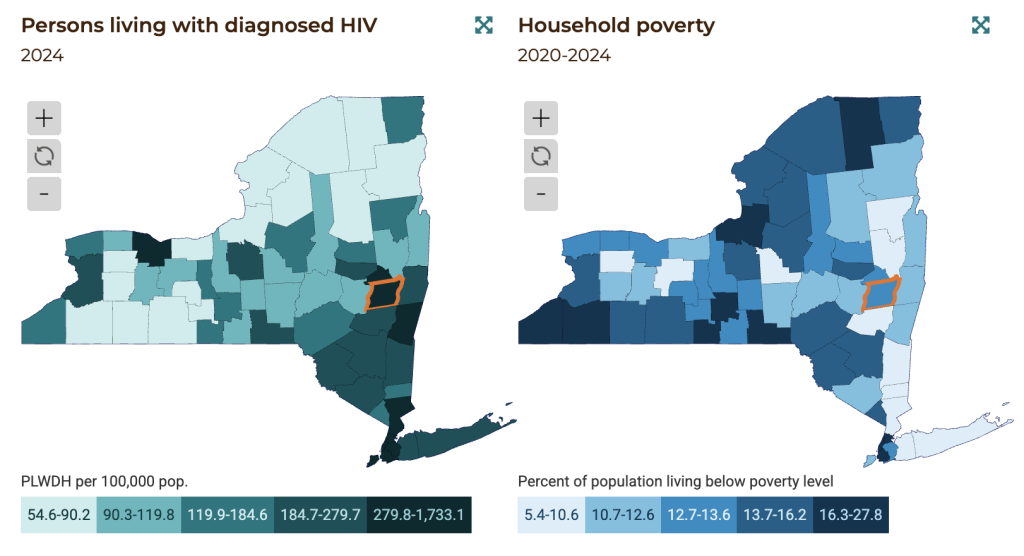
Launched in 2023, the ETE Dashboard’s Social Determinants of Health (SDOH) page highlights HIV-related outcomes alongside social and economic measures at the county level in New York State. The SDOH page now features updated data, a new side-by-side map view, and the option to download visualizations in print-ready PDF format.
Background
Social determinants of health (SDOH) are nonmedical factors that influence various health outcomes. From economic policies to racism or climate change, SDOH encompass the conditions in which people are born, grow, work, live, and age, and the systems shaping the conditions of daily life. Persistent inequities related to SDOH often overlap, such as access to safe housing, income/employment, health insurance coverage, and social support systems, and in some cases, increase health risks and limit access to key resources and opportunities essential for prevention and sustained HIV care.
While we know from looking at years of surveillance data that HIV has a disproportionate impact on some communities, there is a growing body of research that highlights specific impacts SDOH can have on HIV prevention and care related outcomes. National studies have documented an association between the number of SDOH factors people living with HIV report and the care they receive, with a greater number of SDOH factors experienced associated with an increased likelihood of missing medical appointments, reduction in reported medication adherence, and lower likelihood of achieving durable viral suppression.[i] Other studies highlight an association between knowledge of HIV prevention, perception of one’s need for PrEP, ability to access PrEP, and adherence to PrEP with SDOH factors, such as insurance coverage, poverty, rural environment, substance use, and stigma. [ii][iii][iv][v][vi]
Research within the context of New York State and New York City show similar trends. A study at a New York City community-based organization (CBO) that integrates housing and harm reduction into HIV care found that people living with HIV who have experienced homelessness or who report recent illicit substance use are less likely to achieve viral suppression compared to other clients. The same study showed that clients of the CBO who were engaged with the organization for a longer period of time were more likely to be virally suppressed.[vii] Similarly, the Care Coordination Program (CCR) in the Ryan White HIV/AIDS Program Part A, which provides comprehensive support services for housing, substance use, mental healthcare, etc., in addition to HIV medical care, is associated with higher rates of viral suppression as well as lower rates of all-cause and HIV-related mortality.[viii][ix]
SDOH Data in New York State
The SDOH measures featured on this page have been updated with the American Community Survey (ACS) 5-year estimates from 2024, providing a more recent picture of social and economic conditions statewide. Compared with the previous estimates (through 2021), the updated data show increases in household poverty, food insecurity, and the proportion of households experiencing a high housing cost burden. The percentage of people without health insurance has remained stable, and the percentage of adults without a high school diploma has declined slightly
As we have previously explored in our spotlight on housing and its impact on HIV-related outcomes, housing instability has been linked to delays in entering into and sustaining HIV care and poorer treatment adherence.[x][xi] The latest ACS data show that 38% of households across New York State experience a high housing cost burden, although this varies considerably by county.
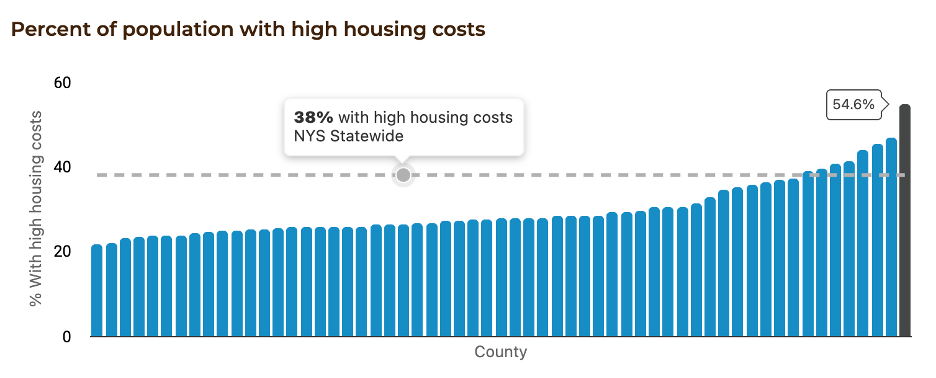
There is notable geographic overlap between counties with high housing cost burdens and those with higher HIV diagnoses rates. Six of the ten counties with the highest housing cost burdens are also among the ten with the highest diagnoses rates. These include all five New York City counties and Westchester County. The new side-by-side map view on the ETE Dashboard makes these geographic patterns easier to identify and compare. While these data visualizations aim to highlight the intersection of housing affordability and HIV, and can help build understanding of how different social and economic conditions may impact HIV-related outcomes, it is important to note that they do not establish causality between the two measures and should be interpreted with caution.
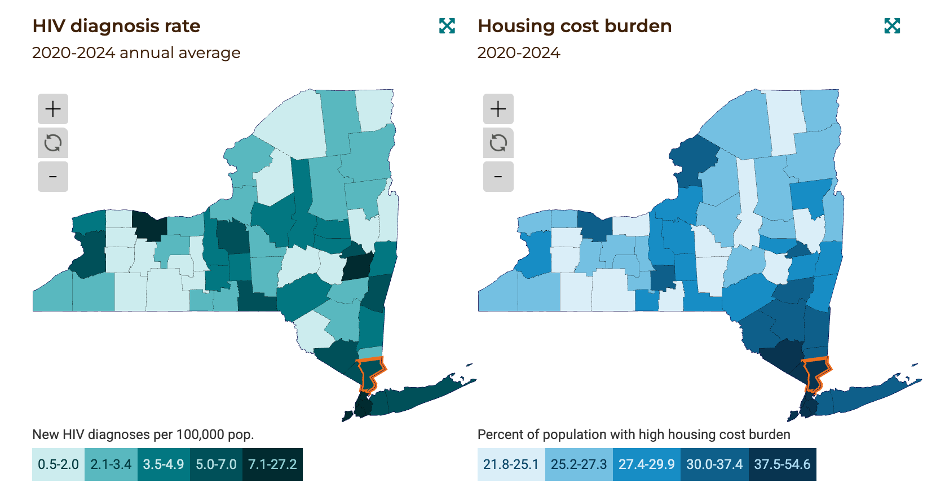
The ETE Dashboard’s newly updated SDOH page provides users the opportunity to explore five SDOH measures alongside key HIV-related outcomes, compare individual counties with statewide averages, and use a new side-by-side map view to more easily identify and compare geographic patterns. The new PDF download features also makes it simpler to save and share findings.
Understanding how social and economic conditions influence HIV prevention and access to care is essential to New York State’s progress toward ending the HIV epidemic. While the relationship between individual SDOH measures (e.g., housing cost burden) and HIV outcomes may vary across communities, exploring these data together can help inform public health research and planning.
Explore the updated Social Determinants of Health and HIV Outcomes page here
Source notes: New York State HIV Surveillance System, 2020–2024; U.S. Census Bureau, American Community Survey 5-year estimates, 2020–2024; County Health Rankings & Roadmaps, University of Wisconsin Population Health Institute (2022 food insecurity data). New York City data are from the New York State HIV Surveillance System and may differ from data reported by the NYC Department of Health and Mental Hygiene. The ETE Dashboard reports data for 59 county areas; Essex and Hamilton, Lewis and St. Lawrence, and Schuyler and Yates counties are combined.
[i] Menza TW, Hixson LK, Lipira L, Drach L. Social Determinants of Health and Care Outcomes Among People With HIV in the United States. Open Forum Infect Dis. 2021 Jun 22;8(7):ofab330. doi: 10.1093/ofid/ofab330. PMID: 34307729; PMCID: PMC8297699.
[ii] Sullivan PS, Sanchez TH, Zlotorzynska M, et al. National trends in HIV pre-exposure prophylaxis awareness, willingness and use among United States men who have sex with men recruited online, 2013 through 2017. Journal of the International AIDS Society. 2020 Mar;23(3):e25461. DOI: 10.1002/jia2.25461. PMID: 32153119; PMCID: PMC7062633.
[iii] Dhir, A.M., Singh, A., Clipman, S.J. et al. Barriers and Facilitators Influencing PrEP Uptake Among Men Who Have Sex with Men and Transgender Women in the United States: A Systematic Review. AIDS Behav 30, 2866–2886 (2026). https://doi-org.ccny.ezproxy.cuny.edu/10.1007/s10461-026-05092-8
[iv] Grov, C., D’Angelo, A.B., Mirzayi, C. et al. High Motivation but Low Access to PrEP: Social Determinants Undermine HIV Prevention Among Sexual and Gender Minority People Who Use Methamphetamine. AIDS Behav (2026). https://doi.org/10.1007/s10461-026-05265-5
[v] Andriano TM, Arnsten J, Patel VV. Social determinants of health and HIV Pre-Exposure Prophylaxis (PrEP) interest and use among young Black and Latinx sexual minority men. PLoS One. 2022 Apr 15;17(4):e0267031. doi: 10.1371/journal.pone.0267031. PMID: 35427397; PMCID: PMC9012374.
[vi] Bradley E, Forsberg K, Betts JE, et al. Factors Affecting Pre-Exposure Prophylaxis Implementation for Women in the United States: A Systematic Review. Journal of Women’s Health. 2019;28(9):1272-1285. doi:10.1089/jwh.2018.7353
[vii] Mazariego, J., Mateu-Gelabert, P., Wyka, K. et al. Evaluation of HIV viral load suppression through a comprehensive intake assessment at a community based organization. Discov Public Health 23, 1481 (2026). https://doi.org/10.1186/s12982-026-02854-6
[viii] Avoundjian T, Robertson MM, Abdelqader F, Braunstein SL, Nash D, Irvine MK. Impact of a Revised Ryan White Part A HIV Care Coordination Program on Viral Suppression and Durable Viral Suppression. J Acquir Immune Defic Syndr. 2026 Jan 1;101(1):77-85. doi: 10.1097/QAI.0000000000003768. PMID: 41380170; PMCID: PMC13220770.
[ix] Robertson MM, Avoundjian T, Abdelqader F, Braunstein SL, Nash D, Irvine MK. Impact of an HIV Care Coordination Program on All-cause, HIV-related, and Non-HIV-related Mortality in Younger and Older Adults With HIV in New York City, 2018-2022. Open Forum Infect Dis. 2026 Apr 23;13(5):ofag206. doi: 10.1093/ofid/ofag206. PMID: 42131623; PMCID: PMC13166153.
[x] Doran KM, Misa EJ, Shah NR. Housing as Health Care: New York’s Boundary-Crossing Experiment. Obstet Gynecol Surv. 2014;69:195. https://doi.org/10.1097/01.ogx.0000446906.02266.3c
[xi] Lockhart E, Llamocca E, Kahn G, Loree A, Turner D. Social Determinants of Health and HIV Diagnosis Rates in U.S. Counties, Comparing Ending the Epidemic (EHE) and Non-EHE Priority Jurisdictions. AIDS Behav. 2026 Jan;30(1):270-281. doi: 10.1007/s10461-025-04865-x.