
Social Determinants Undermine HIV Prevention Among Sexual and Gender Minority People Who Use Methamphetamine
Increasing access to pre-exposure prophylaxis (PrEP) is one of the key aims of the Ending the HIV Epidemic Initiative for New York State. A recently released paper1, led by researchers at the CUNY Institute for Implementation Science in Population Health (ISPH), explores the relationship between recent methamphetamine use and interest in PrEP for HIV prevention among sexual and gender minority (SGM) people.
As part of the American Transformative HIV Study (AMETHST study), researchers collected survey data from over 5,000 sexual and gender minority individuals across the United States beginning in 2022 and planned to continue through 2027. To be eligible for the study, participants were not using PrEP at time of enrollment.
Participants who reported recent methamphetamine use varied from those who had not, in terms of demographic and socioeconomic characteristics, and were more likely to be Non-Hispanic white, bisexual or queer, have a lower income, be unemployed, and have fewer years of education. SGM individuals who used methamphetamines were more likely to report factors associated with increased risk of HIV acquisition, such as housing instability, ever engaging in sex work, ever being incarcerated, more instances of condomless receptive anal sex with male parters, poorer mental health, discrimination and internalized homophobia.
Individuals with recent methamphetamine use were also more likely to express interest in initiating PrEP, including long-acting injectable PrEP. Despite having greater interest in initiating PrEP, study participants who reported recent meth use were more likely to report potential obstacles to obtaining PrEP, including lack of health insurance or a primary care provider, and being less likely to know a provider they would be comfortable asking about PrEP. The authors describe this “Meth-PrEP Paradox” in which people who use methamphetamines recognize their increased risk of acquiring HIV and are more interested in initiating PrEP but also experience barriers to obtaining PrEP. The authors highlight the importance of more tailored support needed for SGM individuals who use PrEP in addition to low or no cost PrEP. Lack of stable employment and housing, access to insurance and health care, and support for poor mental health and other adverse life events impacts how individuals may be able to interact with HIV prevention programs and utilize healthcare.
PrEP Use in the New York State Context
In 2014, only two years after the FDA approved the first PrEP medication, only 3,388 people in New York State (NYS) filled a PrEP prescription. A decade later in 2024, over 60,000 people filled a prescription for PrEP in NYS.
While PrEP use has increased exponentially, there are persistent disparities in PrEP use among New Yorkers. Women, Black, and Hispanic New Yorkers are underrepresented among PrEP users compared to the population of people newly diagnosed with HIV.
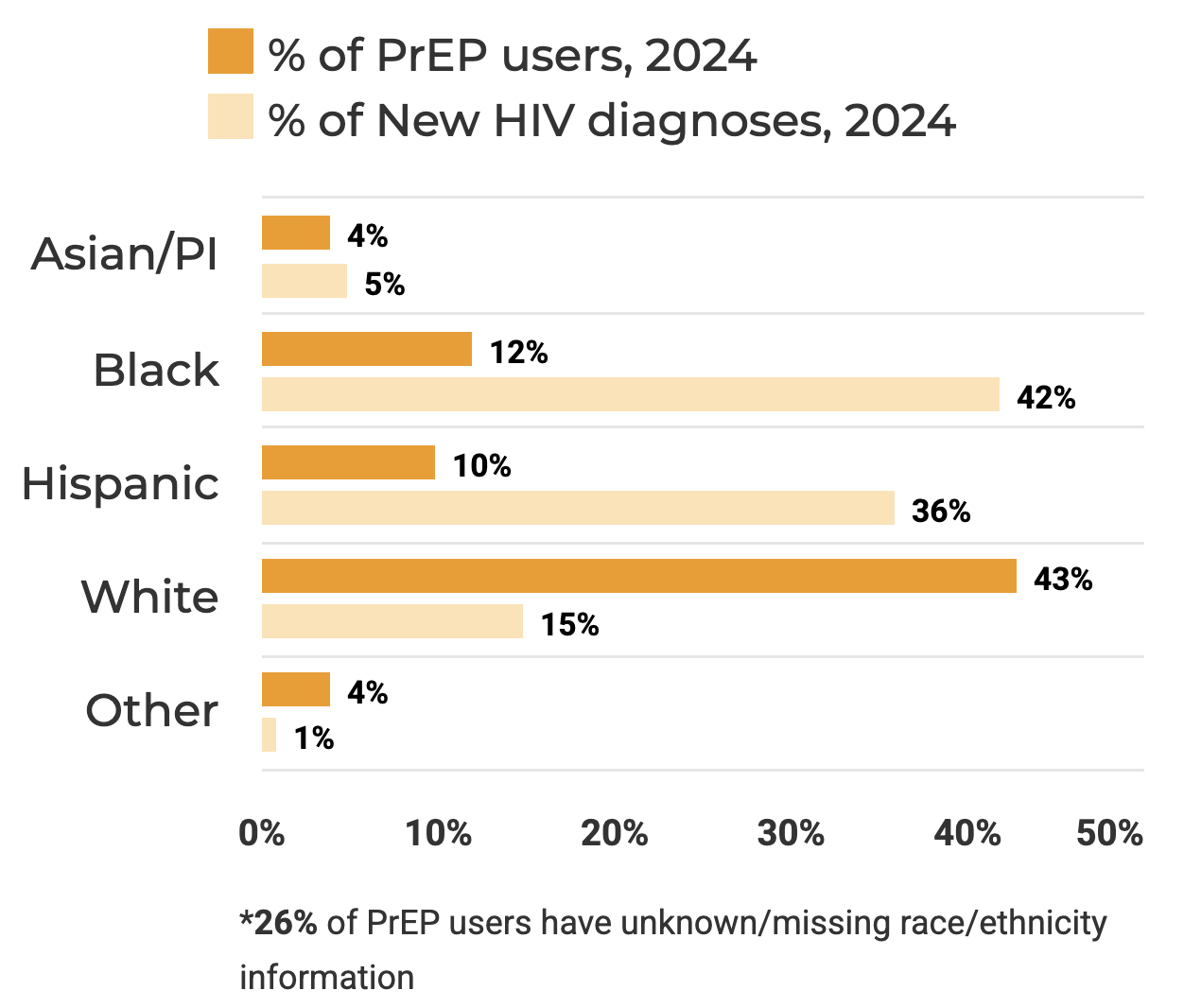
New Yorkers on Medicaid have a higher risk of acquiring HIV but comprise only a quarter of New Yorkers using PrEP.
The source of PrEP data featured on the ETE Dashboard utilizes claims data for number of persons who filled at least one PrEP prescription during a 6 month or 12 month time period.2 While these data provide some insight into PrEP use by sex, age, and race/ethnicity, there are still major gaps, particularly when trying to understand thedisparities around PrEP uptake among those most at risk of acquiring HIV as well as key metrics for individuals who are unable to access, initiate, or stay on PrEP.
Due to the inherent limitations of existing PrEP and HIV surveillance data, the field greatly benefits from rich information from studies such as AMETHST and analyses from Grov et. al. to supplement surveillance and available PrEP use data.
Explore trends in PrEP use in New York State on the ETE Dashboard, as well as population level outcomes among new HIV diagnoses alongside various social determinants of health mentioned in the article, such as, income, education, and insurance status.
For resources on PrEP and PEP in New York State, please visit the NYS Department of Health, AIDS Institute website for further information.
1. Grov, C., D’Angelo, A.B., Mirzayi, C. et al. High Motivation but Low Access to PrEP: Social Determinants Undermine HIV Prevention Among Sexual and Gender Minority People Who Use Methamphetamine. AIDS Behav (2026).
2. ETE Dashboard PrEP utilization data sourced from Symphony Health’s Integrated Dataverse (IDV) and the New York State Medicaid Data Warehouse.